
June 19, 2026
OVRLND vs Tune Outdoor: The Ultimate Full-Top Camper Shell Showdown
OVRLND vs Tune Outdoor: what a full pop-top truck camper actually costs, spec-matched. Real-world pricing, weight, interior space, and tradeoffs for the skinny and wide versions of each.
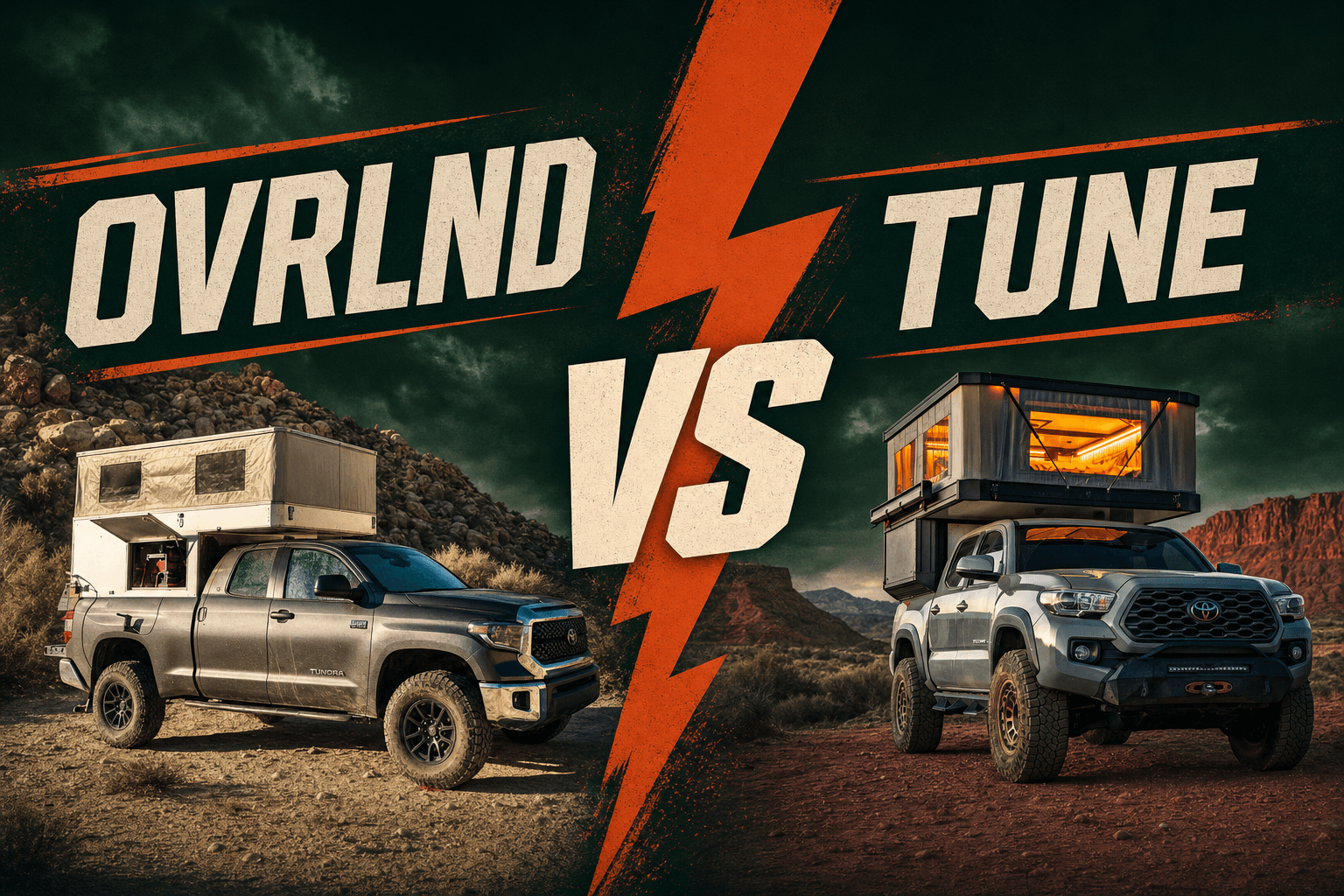
The Short Version
- Choose OVRLND if you want the cheaper, lighter, all-American welded shell with simple fixed-bundle pricing. OVRLND's recommended loaded spec, the Bread 'n' Butter, is a fixed $11,799 ($12,949 with the Chubby width).
- Choose Tune if you want the WingWall east-west interior, the translucent Starlink-friendly roof, and a finished, factory-installed platform with lifetime support, and you are willing to pay for it. A realistically equipped M1, just windows and a bed, runs around $14,000 to $15,000.
The OVRLND and the Tune are the two most popular full pop-top truck campers behind the 4 Wheel Campers Project M. A full pop-top lifts the entire roof straight up so the soft walls rise to full standing height across the front and rear of the bed, unlike a wedge, whose hard lid only hinges up at the rear. You get a true stand-up interior and a large bed while keeping the truck bed open underneath and the closed profile low for the highway. This guide answers the question buyers actually care about: once you add the gear you will actually want, what does each one really cost, and what are you trading off?
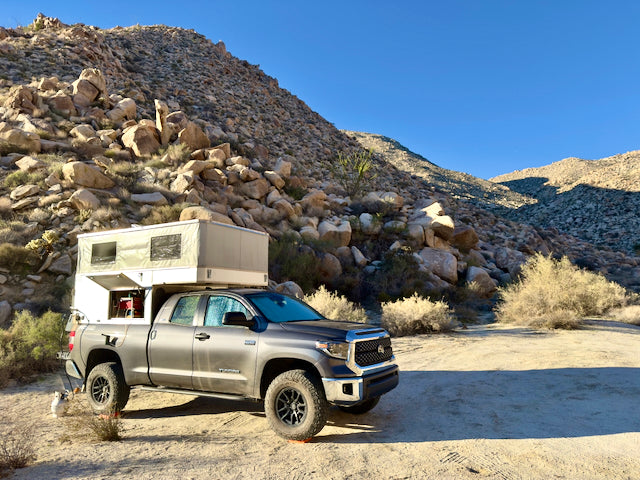 Lighter, cheaper, fixed pricingOVRLND CamperFrom $7,700Fully welded aluminum shell, custom-fit and hand-built in Flagstaff. The recommended Bread 'n' Butter build is a fixed $11,799.View OVRLND Campers →
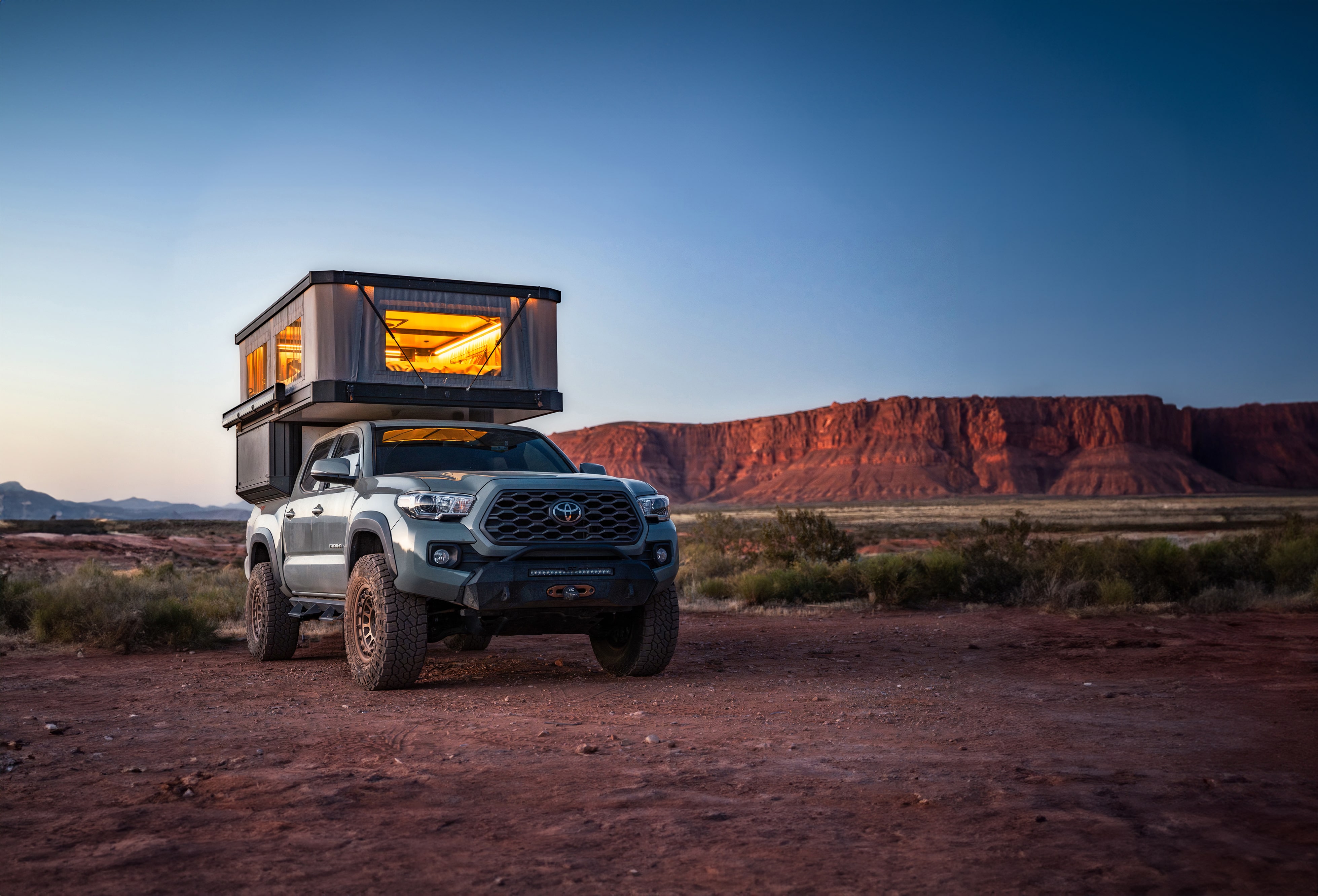 Roomier, premium, modularTune Outdoor M1From $12,999WingWall east-west queen, translucent Starlink-friendly roof, and a showstopper modern design when kitted out.View Tune Outdoor →
Truck-width (skinny): OVRLND standard vs Tune M1L. Matches your truck's width for better mobility on tight trails, easier garaging, and less wind drag. Sleeps north-south.
Wide: OVRLND with the Chubby option (+7 inches) vs Tune M1. Adds living space and unlocks east-west (side-to-side) sleeping on many trucks, at some cost in width, weight, and price.
What it actually costs
Base MSRP is misleading because everyone specs up, and on the Tune even windows and a bed cost extra. So here is each camper at a realistic, comparable build, using OVRLND's recommended Bread 'n' Butter as the reference spec and matching the Tune to it.
Truck-width (skinny)
| OVRLND (standard) | Tune M1L | |
|---|---|---|
| Base shell | All You Can Eat $8,700 | $8,999 |
| Recommended build | Bread 'n' Butter $11,799, popular options plus a 61 x 80 mattress and windows, fixed price | ~$11,000 to $13,000, since windows, a bed, and options add up fast from the $8,999 base |
Wide (east-west)
| OVRLND + Chubby | Tune M1 | |
|---|---|---|
| Base shell | $9,850 | $12,999 |
| Recommended build | Bread 'n' Butter + Chubby $12,949, loaded, east-west on many trucks | ~$14,000 to $15,000, windows and a bed |
| Sleeping | Wider north-south, east-west on many trucks | WingWall east-west queen |
At a comparable, realistically equipped spec, OVRLND is a fixed bundle: $11,799 skinny and $12,949 wide. Tune runs higher and as a range, because windows, the bed, the interior system, insulation, and heat are all à la carte. You are not comparing $8,700 to $8,999. You are comparing a loaded, fixed-price OVRLND against a Tune that climbs past $14,000 before it even has windows and a bed.
Why the Tune costs more
The premium is not arbitrary. A realistically equipped M1 buys you several things the OVRLND does not:
- The WingWall east-west interior. Bump-out walls push past the bed rails for an east-west queen and class-leading volume, about 269 cubic feet on a mid-size truck and 323 on a full-size.
- The translucent roof. It floods the interior with light and lets Starlink and satellite internet work without a dish mounted outside.
- A finished, integrated platform. Factory install at Denver, built-in T-track everywhere, plus the option to add a complete interior system, insulation, glass awnings, and heat.
- Support. A 3-year warranty plus lifetime support, among the strongest in the category.
- A premium, unique design. Kitted out with glass windows and upgrades, the M1 is a genuine showstopper, one of the most modern-looking rigs in the category.
OVRLND goes the other way: a fully welded aluminum shell with fewer factory-integrated systems, simple fixed-bundle pricing, and the lowest weight in the comparison. You trade some integration and support for price, weight, and a fully American-made build.
Weight and payload
Weight decides how much payload is left for water, gear, and people, and this is OVRLND's clearest win.
- OVRLND: the Bread 'n' Butter build stays under 320 lbs, and the stripped Bivy drops under 230.
- Tune: the M1L is around 341 lbs, the M1 around 400 lbs on a Tacoma and closer to 500 on a full-size F-150.
That gap matters most on a stock mid-size truck like a Tacoma or Ranger, where payload is tight once you add people and gear. The WingWall structure that makes the M1 roomy is also what makes it heavier, so wide living space costs you payload headroom.
Interior and sleeping
In the skinny class both campers sleep north-south within the truck's width: the OVRLND on a 60 x 80 queen, the M1L on a north-south queen with a sliding extension. In the wide class they diverge. The Tune M1's WingWall is the most aggressive answer, bumping the walls out for a true east-west queen and the most volume in the comparison. The OVRLND Chubby adds 7 inches of width, which opens up shoulder room and unlocks east-west sleeping on many trucks while keeping the shell in a tidier footprint. If maximum interior volume is the goal, the M1 wins. If you want most of that space at lower weight and cost, the Chubby gets close.
Both campers are three-season as built. Adding a diesel or Truma heater, which Tune can integrate at the factory, extends either one into shoulder-season and winter use.
Construction and repairability
OVRLND welds an aluminum tube frame with PVC-coated polyester canvas and an aluminum roof, hand-built in Flagstaff from North American materials, with no proprietary parts, so it is repairable with standard tools. Tune bolts together 6061 aluminum extrusions with no welds, so a damaged component can be swapped in the field and the modular platform ages well. The trade-off is that Tune draws on a global supply chain, with design, assembly, and install in Denver, while OVRLND is the fully domestic build.
The Bivy: the budget side door
If the goal is the lightest, cheapest way into a full pop-top and you do not need the loaded bundle, OVRLND's Bivy starts at $7,700 and under 230 lbs. It is a stripped shell that you add windows to and build out yourself, but it is the lowest entry point in this comparison and worth knowing about. It is a side option here, not the main event.
Pros and cons
OVRLND: Pros
- Lower real-world price as a fixed, loaded bundle, with no surprise à la carte stacking
- Lightest in the comparison, which protects payload on mid-size and half-ton trucks
- Welded aluminum construction, the same proven approach 4 Wheel Campers has used for decades, and fully American-made
OVRLND: Cons
- Lead times depend on the current build queue, so plan ahead
- Canvas walls need active condensation management in cold or wet weather
- Free install only in Flagstaff, so delivery and freight add cost for distant buyers
Tune: Pros
- WingWall east-west queen and class-leading interior volume in the wide M1
- Translucent Starlink-friendly roof and 440-plus feet of T-track for a connected build
- Premium, ultra-modern design that turns heads, especially kitted out with glass windows and upgrades
Tune: Cons
- Real-world price climbs fast: windows, bed, interior, insulation, and heat are all extra
- Heavier than the OVRLND at every width
- Global supply chain for parts, not fully made in the USA, and a 75 to 90 day lead time on every build
Who should buy which
Decide the width first. If you want a truck-width rig for tight trails, garaging, and fuel economy, you are choosing between the OVRLND standard and the Tune M1L, and OVRLND will usually be lighter and cheaper for a comparable build. If you want the most living space and east-west sleeping, it is the OVRLND Chubby against the Tune M1: the Chubby is the value play at a fixed $12,949, while the M1 is the premium pick if its WingWall volume, translucent roof, finished interior, and showstopper design are worth the jump to $14,000 and up. OVRLND wins on price, weight, and simplicity. Tune wins on interior space, integration, and design. Compare the full field in our full pop-top topper guide or the whole camper directory.
Ready to find your camper?
Compare All Brands