
August 22, 2026
Kimbo 6 vs Scout Yoho: Is the Kimbo Worth $6,000 More? (2026)
Kimbo 6 vs Scout Yoho hard wall compared on one reference build. What the extra $5,955 actually buys, whether the aluminium monocoque claim holds up, and who each camper is really for.
The Short Version
- Choose the Scout Yoho for the mainstream answer done properly. At our reference build it lands at $30,025, and it arrives with the sink, the water, the lithium and the solar already fitted. RVIA certified, a dealer network behind it, and smaller on the outside for the same standing height inside. It is built at scale, and that is precisely why a genuinely excellent four-season camper costs $5,955 less.
- Choose the Kimbo 6 if you are thinking in decades, planning a serious expedition, or you want to arrive somewhere in something nobody else has. The same build costs $35,980, and the extra is not features. It is a hand-riveted aluminium monocoque with no delamination failure mode, repairability decades out with a sheet of aluminium and a rivet gun, scarcity that holds its resale, and craft you notice daily.
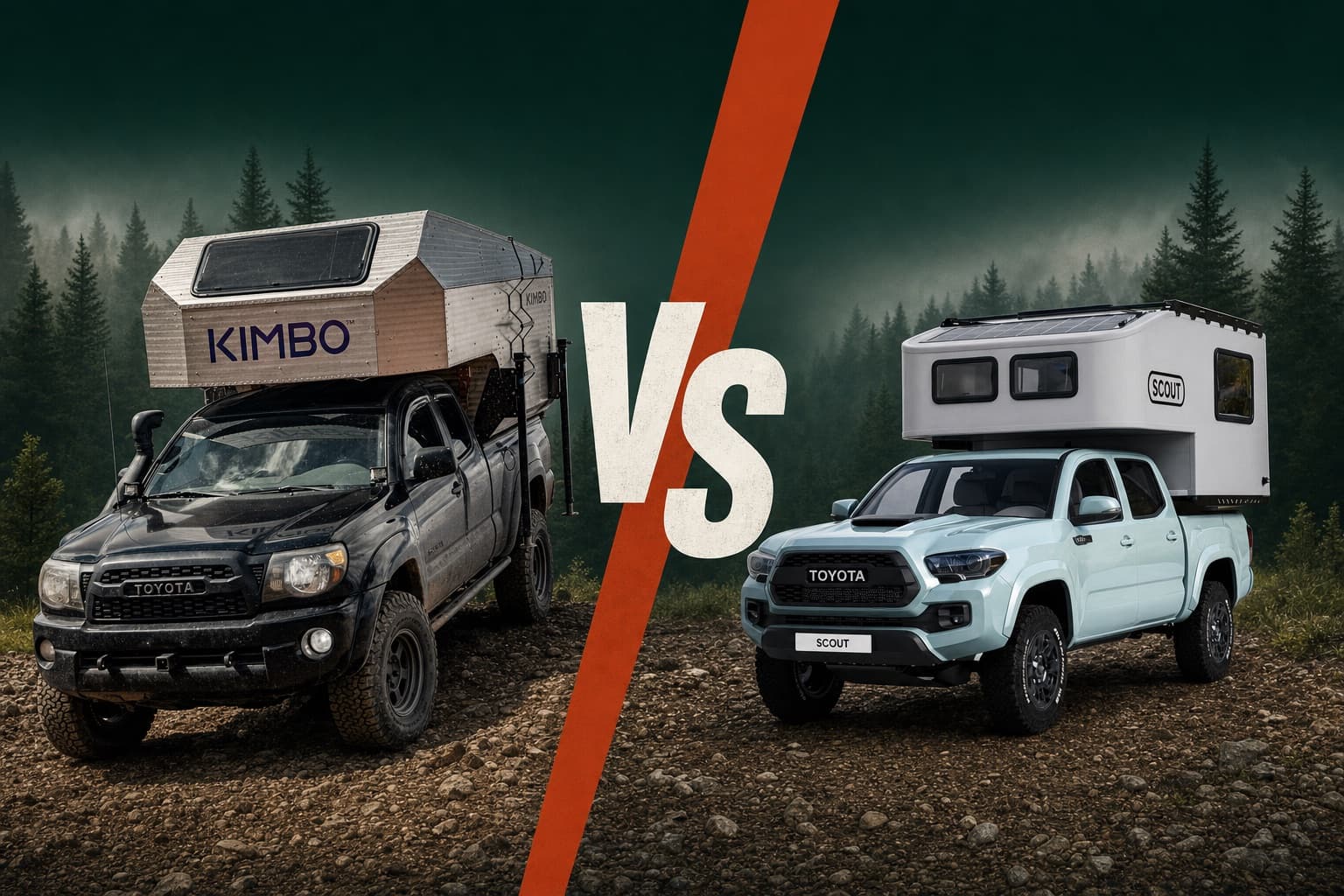
The Kimbo 6 and the Scout Yoho are going after exactly the same person: someone who wants a hard-sided, four-season truck camper light enough to live on a mid-size pickup. Both are built in Washington State, about 250 miles apart. Both will sit on a Tacoma or a Ranger, and both will put that truck close to its payload limit once loaded. They are the two most credible answers to the same question, and they answer it in opposite ways. One is a riveted aluminium shell built in small batches by a founder-run shop in Bellingham. The other is a composite-panel camper built in Yakima by an established RV manufacturer. This guide is about one thing: whether the Kimbo is worth what it costs.
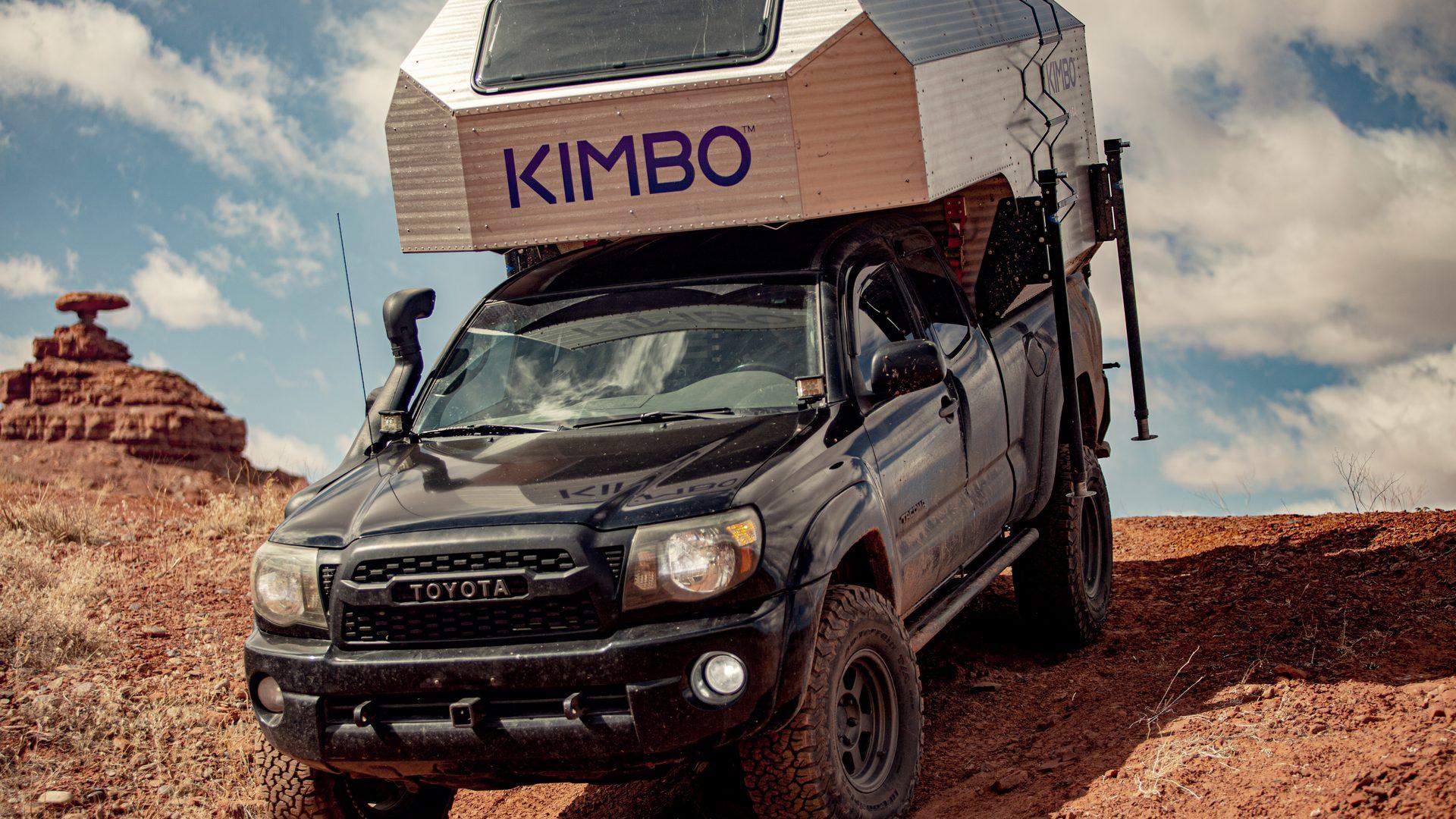 Best long-haul buildKimbo 6From $27,990Frameless riveted aluminium monocoque, hand-built in Bellingham. 830 lb dry, 600+ delivered since 2016.View Kimbo Campers →
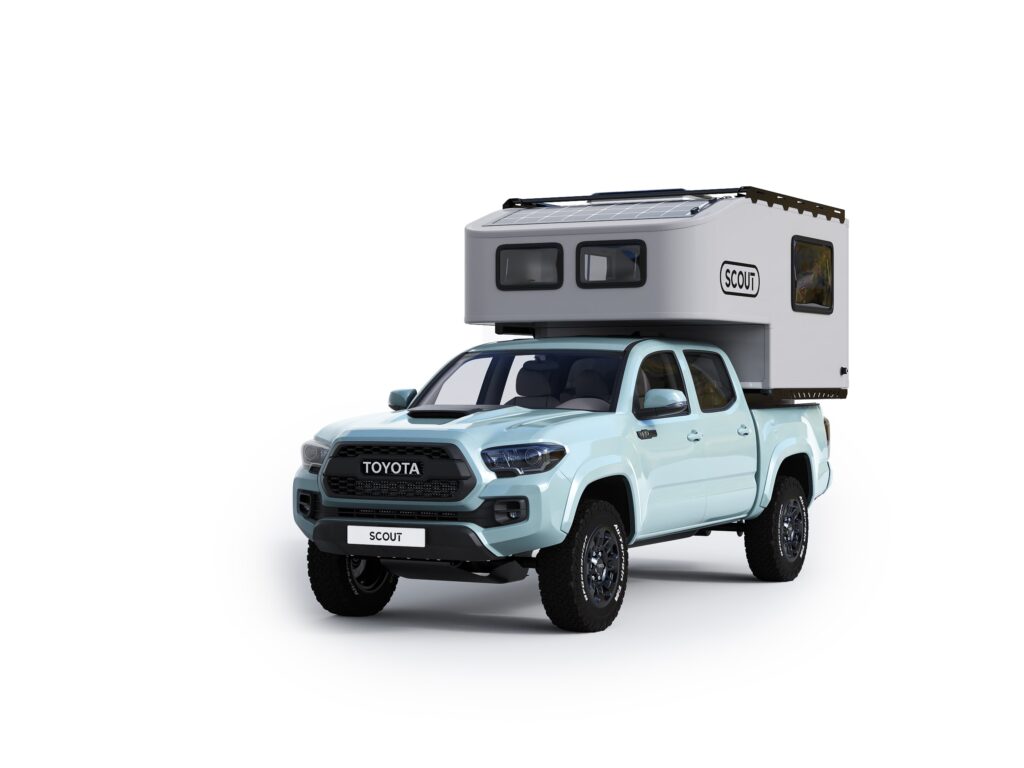 Best valueScout Yoho Hard WallFrom $24,990Aluminium exoskeleton over no-wood composite panels, built by Adventurer Manufacturing. Sink, water, lithium and solar included.View Scout Campers →
What each one comes with stock
Both campers are sold as a base plus options, and neither base is a stripped shell. They are simply equipped differently, which is why holding the two sticker prices next to each other tells you almost nothing useful. Here is what the money actually buys before a single option is ticked.
Standard equipment, as delivered
| Kimbo 6, $27,990 | Scout Yoho Hard Wall, $24,990 | |
|---|---|---|
| Shell | Riveted 0.1 in 5052 aluminium monocoque, single material | Aluminium exoskeleton over no-wood composite panels, gel-coat fiberglass skin |
| Insulation | R5 foam, published | Polyurethane foam, R-value not published |
| Windows | Arctic Tern double-pane, including a panoramic front window, bug screens and blackout shades | Thermal pane with screens and solar shades, plus a moon roof |
| Bed | Full-size memory foam hybrid, 75 x 54 x 8 in | Cabover platform, 50 x 72 in |
| Seating | Sunbrella marine fabric, bamboo entryway and gear closet | Convertible dinette lounge that folds into two extra berths |
| Sink and water | Not included | Stainless 12 x 18 in sink, 4.9 gal filtered Lifesaver can |
| Battery | 12V sealed lead-acid | 132Ah Expion360 lithium, Unbound Power Tower |
| Solar | 120W Renogy | 190W Renogy |
| Ventilation | MaxxAir Deluxe 10-speed reversible with remote | 12V intake and exhaust vent with light |
| Propane | Insulated bay with door, sized for a 20 lb tank | 10 lb tank included, vented compartment, quick-connect |
| Jacks | Brackets and removable jack lifts included | Not included |
| Certification | Not claimed | RVIA code compliant |
| Safety | Smoke, CO2 and propane alarms, extinguisher | Smoke, gas and CO detectors, extinguisher |
Read that table and the pattern is obvious. Scout front-loads the systems: water, a real lithium bank, more solar, a dinette that sleeps two more people, and RVIA certification you may need for insurance or financing. Kimbo front-loads the fabric of the camper: thicker published insulation, double-pane Arctic Tern glass, a proper full-size mattress, a marine-grade interior, jacks and a propane bay. Neither company is being cheap. They have decided different things are essential, and that tells you a lot about who each camper is for.
The practical consequence is that a Kimbo needs a $1,790 module before you can run water in it, and a Scout needs $1,395 before you can lift the camper off the truck. Comparing $27,990 against $24,990 is therefore meaningless. The only honest approach is to pick one build and quote both campers to it.
What a matched build costs
Call it the four-season weekender: running water, a 12V fridge, a heater, and jacks. That is the minimum most buyers in this category actually end up with. Every number in this guide refers back to it.
Reference build: four-season weekender
| Kimbo 6 | Scout Yoho Hard Wall | |
|---|---|---|
| Base camper | $27,990 | $24,990 |
| Sink and fresh water | +$1,790 Kitchen Sink Module | Included |
| 12V fridge | +$3,850, only sold bundled with the power upgrade | +$1,145, 45L Dometic |
| Heater | +$2,350 Dickinson propane | +$2,495 diesel |
| Jacks | Included | +$1,395 removable |
| Reference build | $35,980 | $30,025 |
Comparably equipped, the Kimbo costs $5,955 more. Two details worth flagging. First, you cannot buy a fridge from Kimbo on its own: it only comes bundled with the power upgrade, which does bring a second solar panel and a 2,074Wh Bluetti, so the Kimbo ends up ahead on power, but you do not get to opt out. Second, our $35,980 sits inside the $30,000 to $35,000 range Kimbo's own FAQ quotes for a typical build, so this is not us stacking options unfairly.
Meet both campers
Talon Sei's walkthrough is the most complete Kimbo 6 tour available, filmed on a Tacoma, and it is the one Kimbo themselves point buyers at:
And the Yoho hard wall, in Scout's own factory tour. It is a manufacturer video, so weigh it accordingly, but it is the clearest look at what is included as standard:
The real argument: aluminium monocoque versus composite panel
Everything else in this comparison is detail. This is the actual question.
Kimbo's claim is that the aluminium sheet itself is the frame, the wall and the exterior surface, one continuous structural layer. Fewer joints and interfaces to age, no composite delamination failure mode, and what they describe as single-material repairability decades in, using standard 5052 sheet from any auto-body or aircraft shop. The shell is laser-cut 0.1 inch 5052 marine-grade aluminium, hand-riveted, covered by three patents.
Scout's claim is different, and more modest. An aluminium exoskeleton carries the load, and no-wood composite structural panels with a gel-coat fiberglass skin do the insulating. Nothing in the wall can rot, which is a genuine advance over the wood-framed campers both of these are replacing.
Notice that these are not equivalent promises. Scout is telling you it will not rot. Kimbo is telling you it will not come apart, and that you will be able to fix it forever. The second is a much bigger claim, and it is the one you are paying for.
Does the Kimbo claim actually hold up?
Ten years and more than 600 units in, the honest answer is that the evidence points Kimbo's way without yet proving it.
What supports the claim. The most detailed long-term owner review available, eighteen months on a 2020 Kimbo 6, complains at length about the fridge, the fan, the solar and the water capacity. It never once complains about the shell. The structure held; the bolt-on components disappointed, and every one of those is upgradeable. On the other side of the comparison, a reviewed Scout owner reported interior wall peeling and roof panel separation after a single month of ownership. That is precisely the failure mode Kimbo warns about, observed in the field, and it is the one thing on a composite camper you cannot fix with a better fridge.
What complicates it. One owner report is not a pattern, and we should not pretend otherwise. Scout builds far more campers than Kimbo does, and the overwhelming majority of owners are not reporting panel failures. Kimbo aluminium also scratches easily; that same eighteen-month owner ended up applying bedliner to the wheel wells and exposed surfaces.
Kimbo started building in 2016. That means nobody on earth owns a twenty-year-old Kimbo. The longevity case is an engineering argument, not an observed one. Scout has even less road behind it. Anyone who tells you this question is settled is guessing, and that includes both manufacturers.
Where the Kimbo premium is real
Repairability in year fifteen. This is the argument that actually serves a long-term owner. The question is not whether it breaks, it is whether anyone can fix it when it does. Rivets and 5052 sheet are available in every town with a body shop or an aircraft hangar. A proprietary bonded composite panel is not. Scout has a dealer network today, and that is worth something, but a dealer network is a company, and companies change. A sheet of aluminium is a sheet of aluminium.
A boutique shop instead of a production line. Kimbo's own framing is that Scout runs a factory-based composite-panel supply chain with lower per-unit labour content, while a Kimbo shell takes weeks of hands-on labour. That shows up in how you are treated after the sale. Kimbo is factory-direct: you deal with the people who built your unit, you can visit the workshop in Bellingham, and their owner map lets you go and stand inside someone's rig before you commit. Scout, by contrast, routes through dealers, and one owner reported being told to contact the heater manufacturer or watch YouTube troubleshooting videos. Owners have also noted that finding an authorised dealer depends a lot on where you live. You are not only choosing a camper. You are choosing which relationship you want in year seven.
Resale, because supply is genuinely thin. Kimbo builds in small batches and has a real following, so used units are scarce. Listings turn up three-year-old Series 6 campers asking around $28,000 against a $27,990 base today. Those are asking prices rather than confirmed sales, so treat them as a signal and not a guarantee, but that kind of retention changes how a $5,955 premium looks across a twenty-year hold. Scout's higher volume produces the opposite dynamic: more units in circulation, more normal depreciation.
The way it is made and the way it looks. This is a legitimate reason to buy one and it deserves saying without irony. The Kimbo is a designed object: a riveted aluminium shell, a birch plywood counter, a bamboo entryway and mudroom, Sunbrella marine fabric, a panoramic Arctic Tern window over the bed. Truck Camper Magazine, quoted on Kimbo's own site, called out "the design, the details, the CNC cuts, the integration." RV Travel's review simply nicknamed it the spaceship. The Scout interior is capable and sensible, with composite panel, marine flooring and performance fabrics: well made rather than crafted. If you love the Kimbo's look and the thought in its buildout, that is reason enough. People keep things they love, and that is its own form of durability.
This three-month field review is the closest thing to an answer on the value question from someone who actually paid for one:
Where the Kimbo premium is hard to justify
The monocoque conducts. The same continuous metal layer that never delaminates also carries heat and cold straight through the wall. The eighteen-month owner was blunt about it: the stainless retaining screws readily conduct exterior heat or cold, and the aluminium fins are, in their words, perfectly designed to conduct heat and cold from the skin to the interior. They also found the Dickinson heater fussy to keep lit, with a 10 to 15 degree difference between cabin levels. This is structural. It is not a component you can upgrade your way out of. And it is worth noticing that Kimbo's own comparison pages argue construction, repairability and service, but make no claim to superior four-season or insulation performance. That silence is informative.
Here is a Kimbo through an actual winter trip, which is the fairest way to judge the point:
What $1,790 actually buys you. The Kimbo Kitchen Sink Module is the only way to get water into the camper, so it is effectively mandatory. Here is what it delivers against what Scout includes for nothing.
| Kimbo Kitchen Sink Module, +$1,790 | Scout Yoho, standard | |
|---|---|---|
| Sink | Stainless marine sink in a birch plywood counter | Stainless 12 x 18 in, direct exterior drain, sink cover |
| Water | 2.9 gal undercounter tank | 4.9 gal Lifesaver jerry can with charcoal filter and spray wand |
| Delivery | Plumbed and pressurised, smart-touch faucet | Portable, can be lifted out and used outside |
| Also standard | Nothing further | Lagun table base, marine flooring, 4 cu ft gear locker, convertible dinette |
It is a real trade rather than a rip-off. Kimbo gives you pressurised water at a tap; Scout gives you nearly twice the capacity, filtration, and a jerry can you can carry to the fire. But it is $1,790 to get any water at all into a $27,990 camper, and buyers deserve to know that before they are quoted.
The options stack up fast. Sticker is $27,990. Our reference build is $35,980. That is close to $8,000 of options to reach a specification the Scout largely ships with. Kimbo also advises budgeting another $2,000 to $5,000 for truck-side upgrades such as airbags and payload-rated tyres, which puts a realistic Tacoma setup in the high thirties.
Payload: a problem they share
This is not a reason to pick one over the other, but it belongs in any honest article about hard-sides on mid-size trucks. Kimbo publishes the arithmetic themselves on their Tacoma fit page, and it is sobering. A mid-range Tacoma payload of 1,393 lb, minus a typically loaded Kimbo 6 at 1,052 lb, minus 340 lb of passengers, leaves a remaining margin of 1 lb. Their own page labels it "tight, verify your sticker."
Real credit to Kimbo for publishing a number that inconvenient. But do not read it as a Kimbo problem. A Scout Yoho starts at 929 lb, and once you add the fridge, the heater, water and gear it lands in the same territory. Both of these campers put a mid-size truck at or over its limit. Both buyers need airbags, E-rated tyres, and to read their own door-jamb sticker rather than a mid-range figure from a comparison article.
Scout does have one genuine edge here: its removable jacks come off for travel, dropping 124 lb and taking the camper to roughly 805 lb on the road. Scout also publishes a 26 inch centre of gravity, which is actually useful when you are running the numbers yourself.
What owners say
Recurring themes from owner and reviewer feedback on each camper.
Kimbo 6: Pros
- Riveted single-material shell draws no structural complaints even in detailed long-term reviews
- Repairable with standard aluminium sheet and rivets, with no proprietary panels to source
- Factory-direct support from the people who built the unit, plus factory visits and an owner map
- Thin used supply and a real following appear to hold resale up unusually well
- Genuinely lovely to be inside, with a full-size memory foam bed that beats the Scout for two adults
Kimbo 6: Cons
- Thermal bridging through fasteners and aluminium fins is structural and cannot be upgraded away
- No sink and no water tank until you add $1,790, and the fridge cannot be bought without the power bundle
- Aluminium scratches easily enough that owners add bedliner to exposed surfaces
- Lead time is quoted at 4 to 6 weeks but their own site footer says roughly 12 weeks
- Makes no RVIA compliance claim, which can matter for insurance and financing
Scout Yoho: Pros
- Arrives genuinely ready to camp: sink, filtered water, 132Ah lithium, 190W solar and a convertible dinette all standard
- Roughly $6,000 cheaper at a comparable build
- RVIA code compliant, with a dealer network and hubs in British Columbia and Washington
- Smaller outside for the same 75 inch standing height, at 10 inches shorter and 2.5 inches narrower
- Removable jacks drop 124 lb of travel weight, the lowest real road number in this comparison
Scout Yoho: Cons
- Composite panel construction carries a delamination failure mode, and at least one owner reported wall peeling and roof separation early
- Support can route you to a dealer or a component manufacturer rather than the builder
- Publishes no R-value and no warranty term, so cold-weather performance is hard to verify on paper
- Water is a portable jerry can rather than a plumbed system
- Lead time of 3 to 4 months, roughly double Kimbo's quoted window
This owner reassessment after two months of living in a Yoho is a useful counterweight to the factory tour above:
So is the Kimbo worth it?
Both of these are genuinely good campers, and it is worth saying plainly that neither one is the compromise choice. This comes down to availability and preference far more than it comes down to specification.
The Scout is the mainstream answer, and mainstream is not a criticism. Building at scale through an established RV manufacturer is exactly what puts a fully equipped, wood-free, four-season hard-side on a Tacoma for $5,955 less. You get the water, the lithium, the solar and a convertible dinette already fitted, RVIA certification, a dealer network, and shorter odds of finding one you can actually go and sit in. Scout owners are every bit as devoted as Kimbo owners, and they have not settled for anything.
The Kimbo is for a narrower buyer, and it knows it. It makes sense if you are thinking in decades rather than seasons. It makes sense if you are planning something serious enough that repairing a shell in the field, with rivets and a sheet of aluminium from any body shop, is a real consideration rather than a thought experiment. And it makes sense if you want to pull into a campsite in something nobody else has. That last one is not vanity: the Kimbo is a genuinely distinctive object, hand-built in small batches, and its owners are a cult in the best sense of the word.
Where the money actually goes. The $5,955 does not buy you features, and anyone who tells you otherwise is selling something. It buys longevity, single-material repairability, scarcity that appears to hold resale up, and a level of craft you notice every time you open the door. Whether that is worth it is a question about you rather than about the campers.
What neither camper is: warm without effort. The Kimbo conducts through its skin and the Scout will not tell you its R-value. Neither has a grey water tank. Both put a mid-size truck at its payload limit. Go in with your eyes open on all three.
Scout also sells the Yoho as a pop-up, at $29,990 and 937 lb. That is only 8 lb heavier than the hard wall but $5,000 dearer, so unless you specifically need the lower closed profile for a garage or an underground car park, the hard wall is the better buy of the two. Scout is also teasing a new Sitka Edition for September 2026, which may shift the lineup again.
Still working out which format suits you? Compare the wider field in our guide to hard-sided slide-in campers, or browse every brand in the camper directory. You can also dig into the full specs for Kimbo Campers and Scout Campers.
Prices, weights and specifications verified against kimboliving.com and scoutcampers.com in August 2026. Owner observations are individual reports, attributed where cited, and should not be read as brand-wide patterns.
Ready to find your camper?
Compare All Brands