
November 19, 2026
Alaskan vs Hiatus: Two Hard-Wall Pop-Up Campers, Starting About 1,000 lb and $28,000 Apart
Alaskan vs Hiatus compared: how the hard walls work, real weights against your truck's payload, and what $17,000 versus $44,950 actually buys.
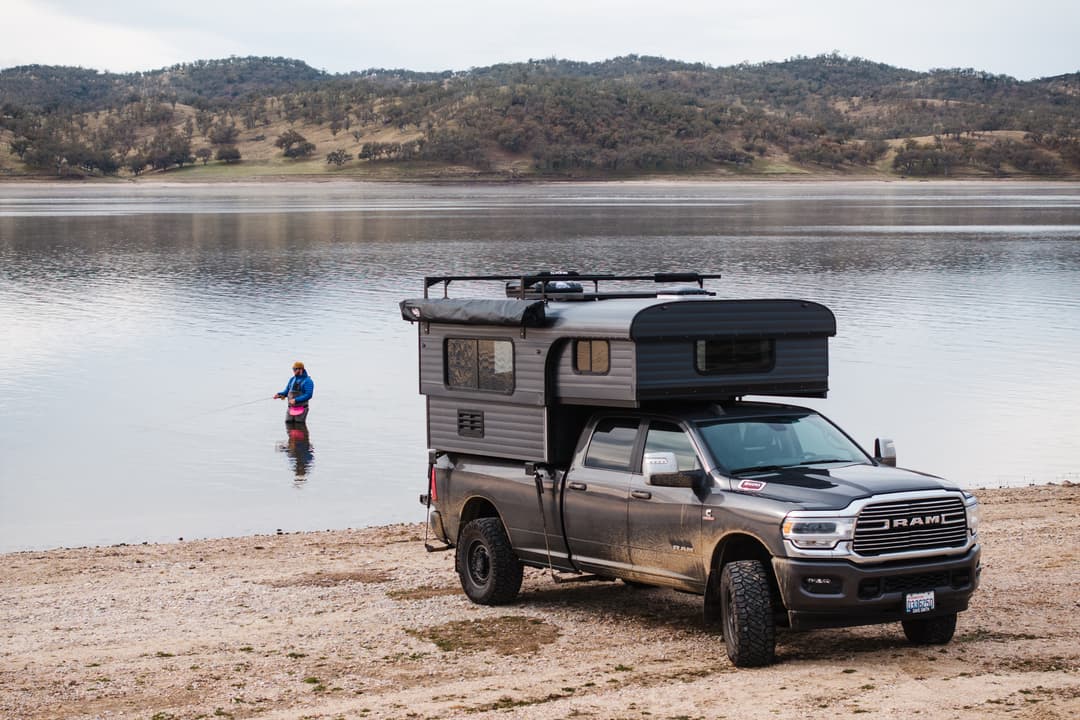
The Short Version
- Start with your truck. Alaskan says its campers weigh about 1,500 to 2,500 lb dry and recommends a 3/4-ton or bigger truck. A Hiatus weighs 460 to 520 lb, light enough for mid-size and half-ton pickups. See Alaskan Campers
- Driving a Tacoma, Ranger, F-150 or Tundra? The Hiatus (from $17,000) is the hard-wall pop-up that fits your payload. Budget for the interior on top. See Hiatus Campers
- Driving a 3/4-ton or 1-ton and want a finished camper? The Alaskan 630 (from $44,950) arrives with a furnace, stove, sink, water, battery and solar, and its walls go up at the push of a button. See Alaskan Campers
- Want to camp by spring? Alaskan quotes four to five months for a custom build. Hiatus lists its install lead time as April 2027. See Hiatus Campers
Search for hard-sided pop-up truck campers and two Washington state builders come up again and again: Alaskan Campers in Winlock and Hiatus Campers in Bellingham. Both sell the same promise. Hard walls instead of canvas, a low roof for the drive, and full standing room at camp.
Line up the spec sheets, though, and they turn out to be barely rivals. The smallest Alaskan weighs about three times what a Hiatus does and costs almost $28,000 more to start. They suit different trucks, different budgets and different kinds of owner. So the useful question is which one your truck can carry, and what you want to build yourself.
Charley runs Overland Addiction and drives a 2014 Tacoma with a 4 Wheel Campers Eagle, not an Alaskan or a Hiatus. This comparison comes from both makers' websites, Alaskan's 2026 slide-in buyer's guide, trade press reviews and owner videos, checked November 19, 2026. Neither company paid to appear here.
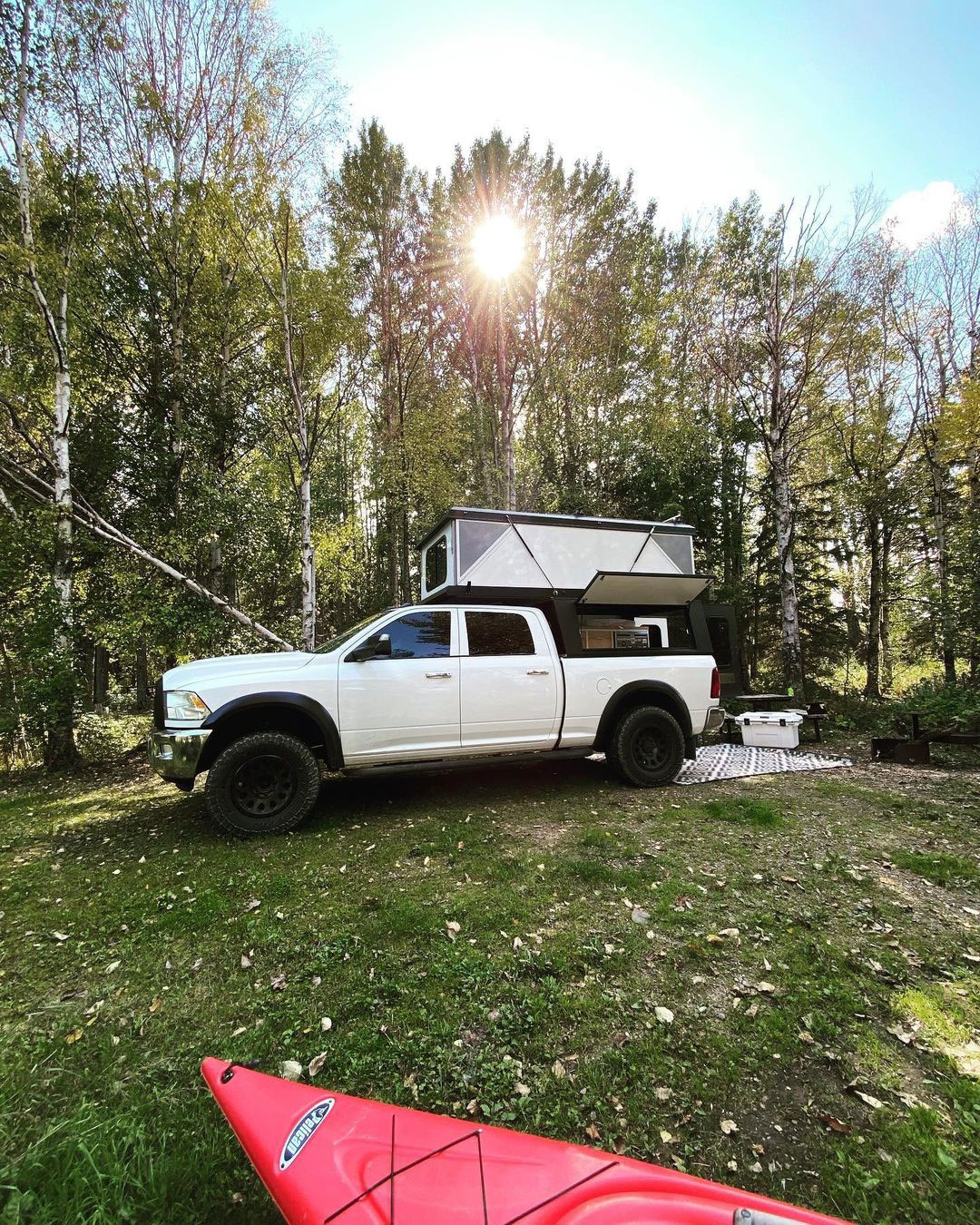 Best for mid-size and half-ton trucksHiatus Mid-SizeFrom $17,000460 to 490 lb, so most of a Tacoma's payload is left for you, your build and your gear.View Hiatus Campers →
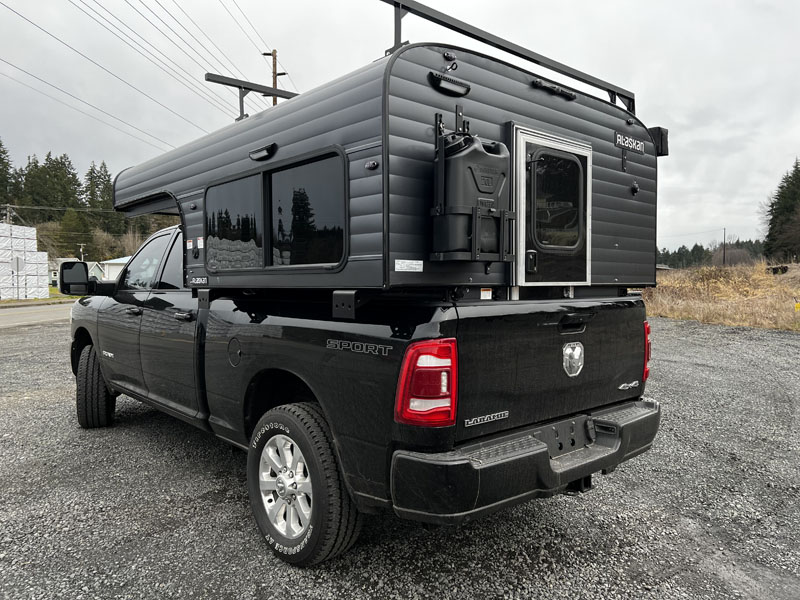 Best finished camper for a 3/4-tonAlaskan 630From $44,950Furnace, stove, sink, 15 gal of water, 200 W of solar and a lithium battery in the base price.View Alaskan Campers →
Side by side
| Alaskan slide-in (630 to 1000) | Hiatus (Mid-Size and Full-Size) | |
|---|---|---|
| Starting price | $44,950 (630) to $55,850 (1000); flatbed from $58,350 | $17,000 (mid-size, 4 to 5 ft bed) to $19,250 (full-size, 8 ft bed) |
| Weight | About 1,500 lb (6.5 ft) to 2,500 lb (10 ft) dry, 1,900 to 2,800 lb wet, per Alaskan | 460 to 490 lb mid-size, 480 to 520 lb full-size, per Hiatus |
| Truck Alaskan or Hiatus recommends | 3/4-ton or larger | Mid-size and full-size pickups, 4 ft to 8 ft beds |
| How the walls go up | Electric-hydraulic lift, telescoping aluminum walls, push of a button | Gas struts lift the roof, hinged composite walls fold out, one person |
| Headroom at camp | 75 to 78 in | 6 ft 1 in to 7 ft, depending on truck and frame style |
| Bed | 44 x 81 in cabover, or 54 x 81 in extended cabover | Platform from 50 x 74 in to 68 x 74 in |
| In the base price | Furnace, 2-burner stove, sink, 15 or 27 gal fresh water, 162 Ah lithium battery, 200 W solar, DC-DC charger, 2 roof fans, R-13 spray foam | The hard-wall shell and lift, one side access door and roof rack tracks; lights, fan, battery and heater are paid upgrades |
| Lead time | 4 to 5 months for a custom build, picked up in Winlock | Install lead time listed as April 2027 |
The one thing they share: hard walls that drop for the drive
Both campers solve the same complaint about canvas pop-ups. Canvas is light and cheap, but it flaps in wind, holds condensation, and is a thin layer between you and the cold or a curious bear. Alaskan and Hiatus both put rigid walls in its place and still fold down low enough to keep the truck's profile sensible on the highway.
Alaskan has done this longer than almost anyone. Alaskan's own history puts its first prototype in 1954 and production in 1958, and The Autopian's 2023 history of the camper describes the original lift as a hand-operated hydraulic pump, with electric pumps arriving in 1990. Hiatus is the newcomer. New Atlas featured it in May 2020 and described walls that fold flat under the roof for travel.
How the walls work, and setup time
Alaskan builds a camper inside a camper. The upper shell telescopes over the lower one, and an electric-hydraulic pump raises it. Truck Camper Magazine's review of an Alaskan 8.5 described a lever marked "RAISE / CAMP" that runs the pump and "LOWER / TRAVEL" that lets the fluid back out. Alaskan's 2026 buyer's guide puts the height to the roof vent at 62.5 in lowered and 83.5 in raised.
Hiatus uses hinged panels. You lift the roof using the exterior handles, gas struts take the weight, and the composite side walls fold out and lock with interior latches. Hiatus's FAQ says one person can do it in under 30 seconds (its homepage says under 15). The walls are fiberglass and plastic composite with a closed-cell foam core, over a base of aluminum tubing wrapped in aluminum skin. Hiatus doesn't publish an R-value.
Both are fast. Neither needs you outside in the rain wrestling canvas. The difference is that the Alaskan's lift is powered and self-contained, while the Hiatus lift is mechanical, with no pump or wiring involved.
Weight and payload: which trucks each one suits
Alaskan doesn't publish a dry weight per model. Its FAQ gives a range of about 1,500 lb for a 6.5 ft camper to 2,500 lb for the 10 ft, and its slide-in page lists wet weights of 1,900 to 2,800 lb. Alaskan's own advice is a 3/4-ton truck or larger. Truck Camper Magazine's 2019 review of an Alaskan 8.5 came to the same conclusion, at an estimated 2,634 lb wet as tested.
Hiatus publishes 460 to 490 lb for mid-size trucks and 480 to 520 lb for full-size. That is light enough for a Tacoma, Ranger, Colorado, Frontier, F-150 or Tundra, with room left for a build-out, water, people and gear. Check the payload sticker on your own door jamb before you buy either one.
If you drive a half-ton and love the Alaskan idea, look at Alaskan's new HS 640 is a lighter composite camper for short beds, built because, in Alaskan's words to Truck Camper Magazine, "We were getting so many calls from half-ton truck owners who loved the idea of an Alaskan." It is a fixed-roof hard-side, not a telescoping pop-up, and Alaskan's builder lists it at 1,500 lb dry and $54,495 as of November 2026, up from the $47,950 starting price Truck Camper Magazine reported in July. The magazine weighed a loaded one at 1,976 lb, so it needs the payload of a well-specced half-ton at the least.
Price: $17,000 vs $44,950, and what the extra buys
The gap is about $28,000 at the bottom of each range, and most of it is the interior.
Alaskan's base price buys a finished camper. Its 2026 buyer's guide lists a forced-air furnace, a two-burner stove, a sink, 15 gal of fresh water (27 gal from the 700 up), a 162 Ah Expion 360 lithium battery, 200 W of solar, a RedArc DC-DC charger, two roof fans and R-13 spray foam insulation as standard. Options climb from there: dual-pane windows are $4,150, a Novakool fridge $1,950, an inside shower $3,600 and a Nomadic air conditioner $4,850.
Hiatus's base price buys the shell: the hard-wall pop-up, the lift, a side access door and roof rack tracks. Hiatus lists LED lights, a Maxxair fan, a Goal Zero battery and a propane heater as paid upgrades, and doesn't list a stove, sink or water tank at all. Owners build the inside to suit, and that is where the rest of the money goes.
So you are weighing a $44,950 finished camper against a $17,000 shell plus whatever you put inside it. If you enjoy building and want to choose every part, the Hiatus wins. If you want to drive away ready to camp in January, the Alaskan's price covers the heat, water and power you would otherwise spend months fitting.
Lead times
Alaskan builds to order and says a custom camper usually takes four to five months, collected at the factory in Winlock. Hiatus's build page lists its current install lead time as April 2027, and its ordering terms ask for a $500 deposit, then 50% about two weeks later, with the balance on install day. Hiatus says deposits are non-refundable, so be sure before you pay.
Alaskan: Pros
- A finished four-season camper in the base price, with heat, water, cooking, battery and solar
- Powered lift that raises the roof at the push of a button
- Nearly seven decades building the same telescoping design
- Extended cabover bed up to 54 x 81 in
Alaskan: Cons
- About 1,500 to 2,500 lb dry, so plan on a 3/4-ton or bigger
- From $44,950, before options
- No per-model dry weights published
Hiatus: Pros
- 460 to 520 lb, light enough for mid-size and half-ton trucks
- From $17,000, the lowest entry price for a hard-wall pop-up here
- Simple mechanical lift, up in under 30 seconds per Hiatus
- Up to 7 ft of headroom on full-size trucks
Hiatus: Cons
- A shell: lights, heat, power and the kitchen are upgrades or your own build
- Install lead time runs to April 2027
- No published R-value for the wall panels
Which one should you buy?
Start with your truck. On a mid-size or half-ton pickup, the Hiatus is the hard-wall pop-up that actually fits, and the Alaskan slide-in is off the table. On a 3/4-ton or 1-ton, both work, and the choice comes down to whether you want to build an interior or buy one.
If you want to compare more hard-wall options, the hard-sided slide-in campers page lists every one in our directory. Weighing up a lighter build? See the lightest truck campers under 1,000 lb and the best truck campers for a Tacoma.
Sources: Alaskan Campers' 2026 Slide-In Buyers Guide (January 2026), alaskancampers.com slide-in, flatbed, HS 640 and FAQ pages, and hiatuscampers.com build-your-rig, product details and FAQ pages, all checked November 19, 2026. Truck Camper Magazine, "Alaskan HS 640 Production Model Debuts" (July 2026) and "2019 Alaskan 8.5FD Review" (March 2019); The Autopian on Alaskan's hydraulic telescoping lift (May 2023); New Atlas on the Hiatus launch (May 2020). Owner videos from The Adventure Addicts and Bazz's Weekend Adventures. Prices are US dollars and exclude options, tax and installation. Payload varies by truck: always use the label on your own door jamb. Header photo courtesy of Alaskan Campers.
Ready to find your camper?
Compare All Brands