
November 2, 2026
4 Wheel Campers vs Go Fast Campers: Two Different Buyers (2026)
4 Wheel Campers and Go Fast Campers are not really rivals. One builds a small home that slides into your truck, the other a bed that bolts to your bed rails. Which buyer you are, what each costs and weighs, what owners complain about, and where Project M and the V2 Max split.

The Short Version
- Choose 4 Wheel Campers if you want to live in your camper: cook inside, stand up, ride out a wet week, and stay out for longer than a weekend. A Fleet or Hawk comes with the fridge, sink, stove, water and lithium battery as standard, at $30,675 as a full camper and about 1,050 to 1,200 lb dry. Budget for the truck to carry it.
- Choose Go Fast Campers if you want a bed that lives on your truck and stays out of the way the rest of the week. A V2 Pro starts at $7,950 and the V2 Max at $10,950, at roughly 275 to 335 lb. You cook at the tailgate and the truck still drives like a truck.
- Torn between Project M and the V2 Max? They look like twins on the spec sheet, 352 lb vs 335 lb and $12,900 vs $10,950, but they are built for different jobs. Jump to the section on those two.
4 Wheel Campers and Go Fast Campers are the two biggest names in lightweight truck campers, so they end up in the same search, and the same "which one should I get" thread. But they are not really competing for the same buyer. One builds a small home that slides into your truck bed. The other builds a tent with a hard shell that bolts to your bed rails. Asking which one is better is a bit like asking whether a cabin is better than a tent. It depends entirely on how you camp.
So this guide does not crown a winner. It helps you work out which kind of buyer you are, then shows you what each brand does well, what owners complain about, and where the one genuinely close matchup in their lineups, Project M against the V2 Max, actually splits.
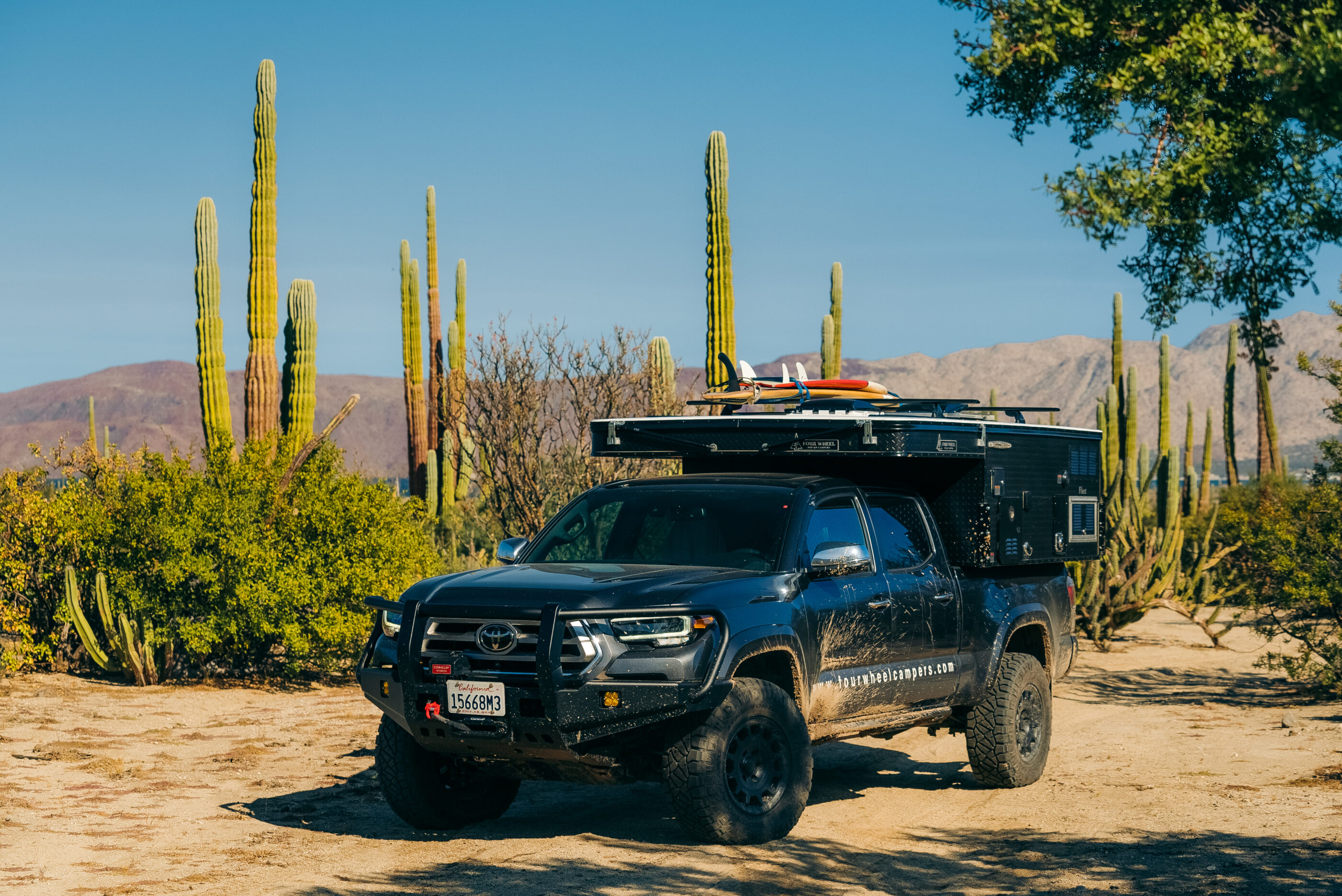 Best for living in it4 Wheel Campers FleetFrom $30,675 (BASE shell $20,800)A full pop-up slide-in for 6 ft mid-size beds: fridge, sink, stove, 20 gal of water and lithium power standard. 1,050 lb dry.View 4 Wheel Campers →
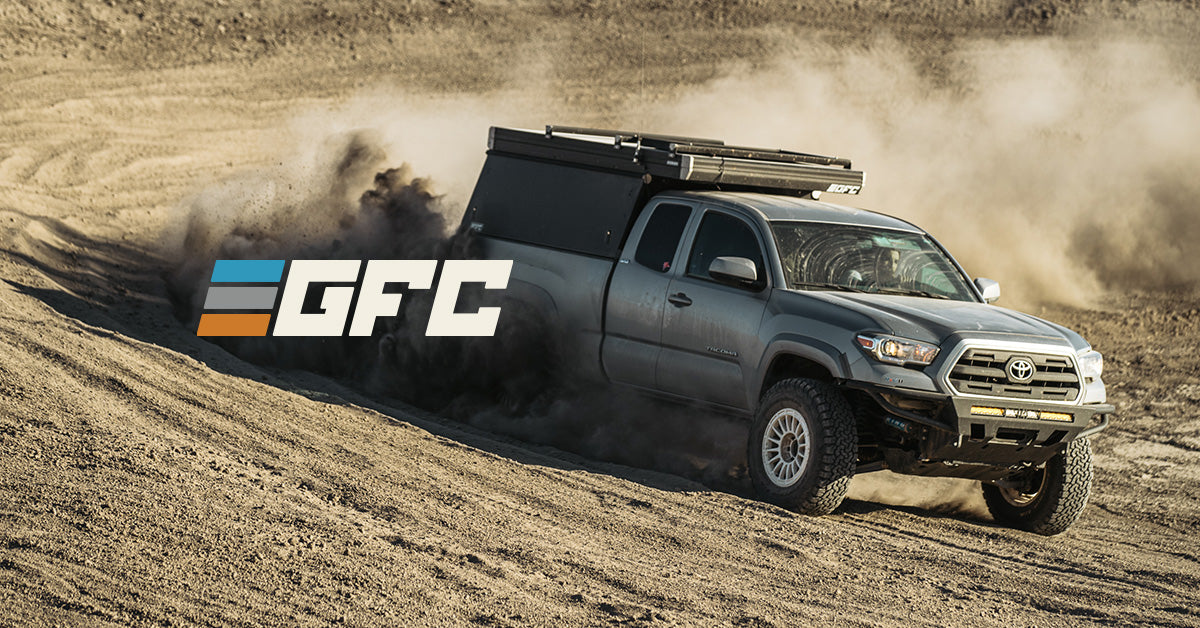 Best for light and simpleGo Fast Campers V2 MaxFrom $10,950A wedge platform camper with an 18 in longer deck than the V2 Pro and pass-through to the bed. About 335 lb.View Go Fast Campers →
Which buyer are you?
Run down this list. If most of your answers land in one column, you have your brand.
| You are a 4 Wheel Campers buyer | You are a Go Fast Campers buyer | |
|---|---|---|
| Typical trip | A week or more, or full-time on the road | Weekends and long weekends |
| Where you cook | Inside, out of the wind and rain | At the tailgate or a camp table |
| Weather | Shoulder season and wet weather are part of the plan | Mostly fair-weather unless you add the $3,199 heater |
| Your truck | Built for the weight, or you are ready to upgrade the suspension | Stock or close to it, and you want it to stay that way |
| The rest of the week | The truck is mostly a camper carrier | The truck is your daily driver and gear hauler |
| All-in budget | About $30,000 to $45,000 before options | About $8,000 to $12,000 before options |
How they compare at a glance
| 4WC Fleet | 4WC Hawk | 4WC Project M | GFC V2 Max | GFC V2 Pro | |
|---|---|---|---|---|---|
| Type | Pop-up slide-in | Pop-up slide-in | Pop-up topper, bolts to the bed rails | Wedge platform camper, bolts to the bed rails | Wedge platform camper, bolts to the bed rails |
| Starting price | $30,675 full camper, $20,800 BASE shell | $30,675 full camper, $20,800 BASE shell | $12,900 (5 ft), $13,100 (6 ft), $13,950 (8 ft) | $10,950 mid-size, $11,450 full-size | $7,950 mid-size, $8,450 full-size |
| Weight | 1,050 lb dry | 1,200 lb dry | 352 to 465 lb, by bed size | From 335 lb (mid) / 360 lb (full) | About 275 lb |
| Fits | Mid-size, 6 ft beds | Full-size, 6 to 6.5 ft beds | Most mid-size and full-size trucks, plus the Jeep Gladiator | Most mid-size and full-size trucks | Most mid-size and full-size trucks |
| Interior height, open | 6 ft 4 in | 6 ft 6 in | 57 in plus your bed depth (mid-size) | Not published | Not published |
| Kitchen and water | Fridge, sink, stove, 20 gal water standard | Fridge, sink, stove, 20 gal water standard | None, it is an empty shell | None | None |
| Heat | Truma furnace, +$2,400 | Truma furnace, +$2,400 | Thermal pack +$1,450, no furnace | GFC diesel heater kit, $3,199 option | Not published |
| How you buy | Through dealers, about 2 to 3 months lead time | Through dealers, about 2 to 3 months lead time | Through dealers | Direct online, installed in Montana or at a partner shop | Direct online, installed in Montana or at a partner shop |
| Built in | Woodland, California | Woodland, California | Woodland, California | Manhattan, Montana | Manhattan, Montana |
The 4 Wheel Campers buyer: a small home that pops up
4 Wheel Campers has been building pop-up campers in California since 1972, and the full models are complete campers. A Fleet or Hawk comes with a 65 L two-way fridge, a sink with a pump, a two-burner propane stove, a 20 gallon fresh water tank, a lithium battery, solar pre-wiring and 30 A shore power. Pop the roof and you get 6 ft 4 in of standing room in the Fleet and 6 ft 6 in in the Hawk, with a cabover bed above the cab. That is the whole pitch: you can stand up, cook dinner and wait out a storm without going outside.
The lineup covers most trucks. The Swift and Fleet are for mid-size beds (5 ft and 6 ft), the Raven, Hawk and Grandby for full-size beds (5.5, 6 to 6.5 and 8 ft), and there are flatbed versions from $43,150 up to the new Hawk+ flatbed at $47,850 for heavy-duty trucks. If you want the shell without the kitchen, the BASE models drop the fridge, sink and shower but keep the battery and solar pre-wire, from $20,275.
What it costs you:
- Weight. 1,050 lb dry for a Fleet and 1,200 lb for a Hawk, before water, gear, food and people. On a mid-size truck that is close to the payload limit, and owners commonly add suspension work to carry it well.
- Money. $30,675 is the starting point for a full Fleet or Hawk, and the spec sheet's option packages take a Hawk as high as $63,550. A $900 standard installation with wiring is required on the slide-ins.
- The truck stops being just a truck. A slide-in can come off, but most owners leave it on for the season. Your bed is the camper.
The Go Fast Campers buyer: a bed that rides on your bed rails
Go Fast Campers builds its campers in Manhattan, Montana, and says it invented the modern wedge camper in 2017. A GFC is a light aluminum and composite shell that bolts to your bed rails, with a tent wall that lifts on struts and a sleeping platform up top. The V2 Pro is the original idea refined: a 96 in platform, a sleeping area of 50 by 90 in on a mid-size truck, from $7,950. The V2 Max stretches the platform to 114 in, adds 6 to 8 in of height over the cab, gives you a 50 by 108 in sleeping area, and keeps a pass-through to the bed open even with the bed deployed.
What you do not get is a kitchen, plumbing or heat. The V2 Max comes with an insulating headliner, five-zone lighting, a MOLLE panel and pre-wiring for solar and Starlink. GFC now sells its own diesel heater kit for every V2, at $3,199. Everything else, from fridge slides to awnings, comes from GFC's own accessory catalog or the large aftermarket around it.
What it costs you:
- Living space. It is a bedroom, not a house. In bad weather you are in bed or in the cab.
- Weather. Fabric walls make it a cold-weather compromise even with GFC's $3,199 heater kit. Plan on a sleeping bag rated for the trip.
- Distance to an installer. You buy direct, and installation takes about an hour at the Montana factory or a partner shop. GFC ships when a full truckload is heading to your installer, so allow another 2 to 4 weeks for an install date once your camper is built.
Project M vs V2 Max: twins on paper, different in practice
This is the one place the two lineups really meet. Both bolt to your bed rails, both are built around an aluminum frame, both weigh around 350 lb, and they are $1,950 apart. On a spec table they look interchangeable. In use they are not.
| 4WC Project M | GFC V2 Max | |
|---|---|---|
| Price | $12,900 (5 ft bed) | $10,950 (mid-size) |
| Weight | 352 lb (5 ft, mid-size) | From 335 lb (mid-size) |
| Shape when open | The whole roof lifts level, a box at full height end to end | A wedge, tall at one end and tapering to the hinge |
| Bed | 81 by 66 in, sleeping across the truck | 50 by 108 in, sleeping lengthwise |
| Walls | Insulated aluminum sides, rear hatch door | Strut-lifted fabric walls, removable side panels |
| Roof load | Up to 100 lb of gear | 500 lb closed, 50 lb open |
| Mattress | Optional, +$875 | Not stated |
| Power | Pre-wired, lithium +$3,200 | Pre-wired for solar and Starlink |
Project M is an empty room. It is essentially a 4 Wheel Campers shell with nothing inside: insulated walls, a flat roof that lifts level on gas struts, and a rear hatch, for you to fit out. Because the roof lifts level, the whole box gains height at once, which is what makes it feel bigger inside than a wedge of the same weight. It is the pick if you want to build your own interior with a bed platform, drawers and a fridge, and you want hard, insulated walls around it. Plan on the options: the mattress, power, fan and jacks all cost extra. 4WC's 2026 Project M owner's manual lists a 1 year materials and workmanship warranty and 5 years on the structure; GFC's published warranty is 2 years.
The V2 Max is a bed with a gear bay underneath. The sleeping platform is the point, the truck bed below stays a storage space, and the pass-through lets you get from the cab to the bed without going outside. It is the pick if your camping is mostly sleeping, you want the roof to carry a real load of gear or solar, and you would rather bolt on accessories than build an interior.
What owners say
Recurring themes from owner reviews and the GFC owners' forum. These are individual reports, not brand-wide patterns.
4 Wheel Campers: Pros
- A tough, long-proven build, with a strut-assisted roof that owners describe as about a two-minute setup
- Feels far bigger inside than a wedge, especially once the roof is up
- A complete kitchen and water system from the factory, with nothing to source
4 Wheel Campers: Cons
- The soft pop-up walls move and flap in strong wind
- One long-term owner found the 20 gallons of water lasts four to five days
- Fridge noise and cabinet finish came up in the same owner's review
- On a mid-size truck, owners report needing suspension upgrades to carry it well
Go Fast Campers: Pros
- Light enough to live on a daily driver without changing how it drives
- Simple and durable, with very little to go wrong
- A huge accessory and aftermarket ecosystem
Go Fast Campers: Cons
- Several V2 Max owners on GFC's own forum reported tent fabric wearing at the struts within a few nights of use (August 2026). GFC's response described it as operator error
- Rain dripping onto the driver's side when opening, and six latches to work
- Noise and movement in crosswinds, and some reports of water getting in
So which one?
If you are picturing a week in the mountains in October, dinner on the stove while it rains, and the truck as the thing that carries your camper, you are a 4 Wheel Campers buyer. Price it at $30,000 and up, and check your payload before you check your colors.
If you are picturing Friday night at the trailhead, a bed that is already made, and Monday morning in the same truck at the hardware store, you are a Go Fast Campers buyer. The V2 Pro at $7,950 is the lowest entry price in this comparison by a long way, and the V2 Max is worth the extra $3,000 if you want the longer bed and the pass-through.
And if you want hard walls and a blank canvas at a GFC weight, look hard at Project M, but price it with the options you will actually need.
Want a hard-sided pop-up but lighter than a 4WC? Compare the field in slide-in pop-up campers. Want a wedge but with factory heat? Read Super Pacific X1 vs GFC V2, or browse every wedge pop-up topper.
Still deciding? Dig into the full specs for 4 Wheel Campers and Go Fast Campers, or browse every brand in the camper directory.
Prices, weights and specifications verified against fourwheelcampers.com (September 2026 spec sheets) and gofastcampers.com in November 2026. Owner observations come from published owner reviews and the GFC owners' forum, and should not be read as brand-wide patterns.
Ready to find your camper?
Compare All Brands